Project Rationale
Researching the Chemistry of Cooking Club is important because hands-on, food-based learning provides a powerful way to strengthen students’ engagement in mathematics and science. By integrating food preparation and cooking, this project explores how experiential learning may shift students’ perceptions of their abilities in core academic subjects. Understanding these effects is valuable to my practice because it supports more meaningful STEM instruction and helps educators design programs that increase confidence, curiosity, and academic persistence. This research can benefit others in the field by demonstrating how applied, interdisciplinary, and real-world learning experiences improve student attitudes toward math and science.
Project Context
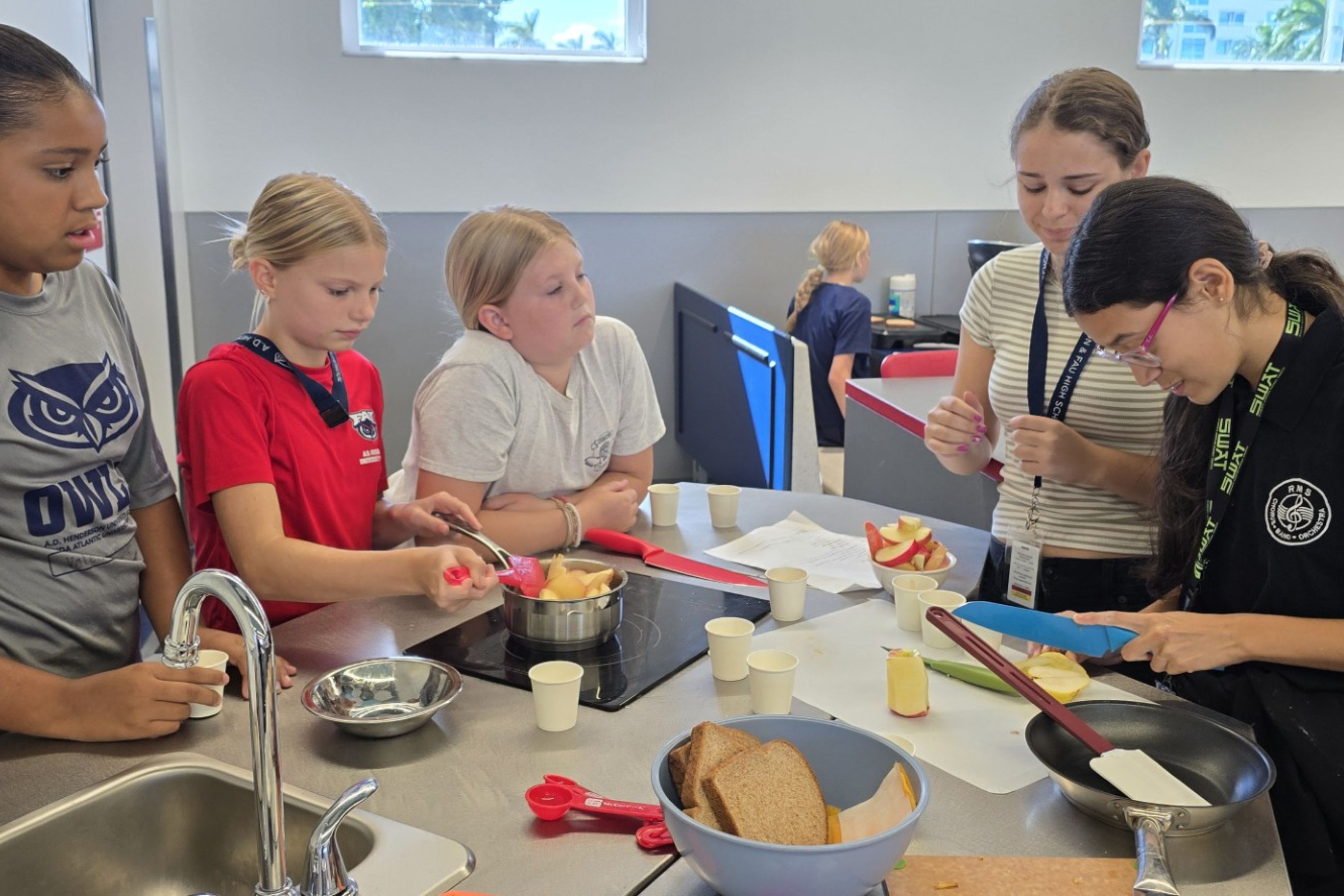
This research was conducted at A.D. Henderson University School, a public laboratory school serving a diverse population of students in grades K–12. The study focuses specifically on middle school participants in grades 6–8 who are enrolled in the afterschool Chemistry of Cooking Club. Students meet weekly to engage in food preparation and cooking activities connected to mathematics and science concepts. The school provides a supportive environment for project-based and inquiry-based learning, making it an ideal setting to study how experiential food-based learning influences students’ perceptions of success in STEM. Participants include both returning and first-year club members.
Supportive Literature
Students’ Perceptions of STEM Learning After Learning Experience
Experiential and inquiry-based learning environments, such as the Chemistry of Cooking Club, have been shown to enhance student engagement, self-efficacy, and interest in STEM disciplines (Roberts et al., 2018). This study examined the impact of an informal STEM summer learning experience on students’ attitudes, perceptions, and preparedness for school-based math and science. Findings suggest that motivation, self-efficacy, and hands-on experiences play a key role in shaping students’ perceptions of STEM. Unlike traditional classroom settings, the informal program provided collaborative, real-world learning opportunities, including access to authentic STEM environments and interactions with professionals. These experiences helped deepen content understanding and enhanced student engagement by offering opportunities not typically available in formal education settings.
Integrated STEM education and Student Attitudinal Change
Another study conducted and published in the Journal of Chemical Education found that kitchen chemistry has emerged as an effective strategy for making STEM learning relevant through real-world applications such as cooking. Research indicates that participation in kitchen chemistry experiences is associated with increased STEM identity and career interest among students. Notably, these experiences have a stronger positive impact on STEM identity for girls, helping to reduce gender gaps, while boosting STEM-related career interests across all students regardless of gender or race/ethnicity (Chen et al, 2024).
Methodology
Research was conducted during the Chemistry of Cooking Club held at A.D. Henderson University School. The participants were 27 sixth graders, 18 seventh graders and 16 eighth graders, for a total of 61 students. 25 students were male, and 36 were female. The club meets on Fridays after school from 3:00 pm to 4:45 pm. Students of all backgrounds and skills can participate, including both traditional and ESE/504 students. The main objective of the club is to teach the scientific and mathematical principles behind cooking through hands-on activities, lessons, and food preparation. By demystifying cooking, we show that recipes are essentially chemical experiments that encourage inquiry and hypothesis testing. This instructional approach employs an interdisciplinary, experiential learning framework that integrates principles of technology, engineering, and mathematics within structured culinary activities. Sessions are designed to facilitate hands-on engagement, allowing participants to identify and apply theoretical STEM concepts to food science-based tasks. Through repeated practice and guided inquiry, students develop proficiency in essential culinary skills while strengthening their ability to recognize and apply STEM principles in authentic, real-world contexts.
Data Collection
Students were given pre/post surveys about how they felt about their mathematics and science skills both before and after they participated in the Chemistry of Cooking Club. Small group interviews were conducted with 11 students that attend Chemistry of Cooking Club to get a picture of how they are feeling about their own perceptions of recognizing and analyzing math and science as applied during their club experience. The study took place over 6 months, with the first survey given at the initial meeting. Follow-up surveys were conducted 6 times every few weeks after the club meeting, and small group interviews were conducted 3 times as students were participating in their club activities.
Results
This study examined changes in middle school students’ perceptions of mathematics and science following participation in the Chemistry of Cooking Club using a mixed-methods, pre/post survey design. A total of 58 students completed the pre-survey, and 54 students completed the post-survey. Four students dropped out of club due to sports commitments. The results indicate three main themes:
Consistent Confidence in Successful Abilities
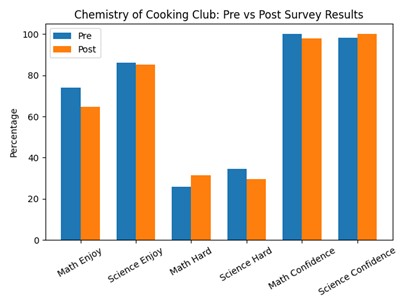
Findings indicate that student confidence in their ability to succeed remained exceptionally high across both content areas. For mathematics, 100% of students (58/58) reported agreement with the statement “I can get good grades in math” in the pre-survey, compared to 98.1% (53/54) in the post-survey. Similarly, science self-efficacy remained strong, increasing slightly from 98.3% (57/58) to 100% (54/54). These results suggest that participation in the program successfully maintained high levels of academic confidence, a critical predictor of student achievement and persistence in STEM fields.
Enjoyment in Science and Mathematics
Student enjoyment of science remained consistently high, with 86.2% (50/58) of students reporting enjoyment in the pre-survey and 85.2% (46/54) in the post-survey. In mathematics, enjoyment decreased slightly from 74.1% (43/58) to 64.8% (35/54). While this represents a modest decline in math enjoyment, most students continued to report positive attitudes toward the subject. During the Focus group I interviewed, one student reported that after participating in the Chemistry of Cooking Club, “Math and science seem more approachable in things every day”. Another claimed they are “see(ing) math and science more in everyday life than in school”. That awareness is indicative of metacognition that allows students to shift from passive learning to active, thus enabling evaluation of their learning strategies for improved performance. The consistently high enjoyment of science suggests that the program was particularly effective in fostering engagement in science-related learning
Difficulty in Mathematics and Science
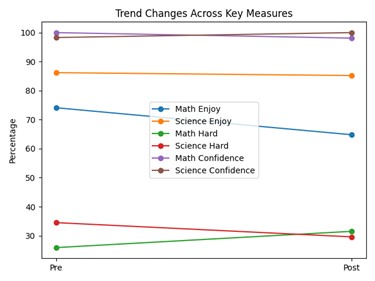
Perceptions of difficulty showed nuanced changes. The percentage of students who agreed that “math is hard for me” increased from 25.9% (15/58) to 31.5% (17/54). In contrast, perceptions of science difficulty decreased from 34.5% (20/58) to 29.6% (16/54). These findings indicate a divergent trend, with students perceiving math as more challenging while experiencing increased ease in science. These shifts likely reflect deeper cognitive engagement and a more authentic understanding of mathematical concepts rather than a decline in ability. Additionally, student expectations in mathematics shifted toward more realistic self-assessment, while confidence in science outcomes increased. Overall, findings suggest that interdisciplinary, experiential learning environments effectively promote student confidence, engagement, and critical awareness in STEM disciplines.
Implications
Findings from the Chemistry of Cooking Club indicate that engaging middle school students in preparing their own food within an interdisciplinary, hands-on STEM environment positively influences their perceptions of mathematics and science, particularly by sustaining high levels of confidence and strengthening engagement in science. Students consistently reported strong self-efficacy in both subjects, with science showing stable enjoyment and even increased expectations for success. While perceptions of mathematics became slightly more challenging and enjoyment decreased modestly, these shifts appear to reflect deeper cognitive engagement and increased academic self-awareness, rather than diminished ability or interest.
Congruence With Previous Studies
These findings align with existing literature on informal STEM learning and kitchen chemistry, which suggests that experiential, real-world applications enhance motivation, engagement, and STEM identity. Consistent with prior research, this study supports the idea that hands-on, collaborative environments promote meaningful learning experiences that extend beyond traditional classroom instruction. Although this study did not directly measure STEM identity or career interest, the sustained confidence and increased engagement observed, especially in science, suggest similar positive developmental trends. The increased recognition of difficulty in mathematics also supports research indicating that authentic learning experiences can lead students to develop more accurate and mature perceptions of academic challenges.
Integration of Experiential STEM Opportunities
For educators, these findings are important because they demonstrate that learning environments do not need to simplify content to improve student outcomes. Instead, providing opportunities for students to engage in complex, real-world problem-solving (such as cooking), can maintain confidence while promoting deeper understanding. The results also highlight the value of informal and interdisciplinary learning spaces, which allow students to collaborate, experiment, and apply concepts in meaningful ways that are often not feasible in traditional settings.
Moving forward, educators should consider integrating experiential, inquiry-based STEM opportunities into both formal and informal learning environments. Programs like the Chemistry of Cooking Club can serve as effective models for increasing engagement, particularly in science, while also fostering critical thinking and self-awareness in mathematics. Future efforts should explore ways to further support positive perceptions of mathematics within these contexts and examine long-term impacts on STEM identity and career pathways. Ultimately, this study suggests that making STEM relevant, hands-on, and connected to everyday life is a powerful strategy for shaping how students think and feel about learning.
References
Chen, C., Chen, J., Ju, L., Sonnert, G., Sunbury, S., and Sadler, P. Journal of Chemical Education 2024 101 (7), 2618-2629 DOI: 10.1021/acs.jchemed.3c01141
Creswell, J. W., & Plano Clark, V. L. (2011). Designing and conducting mixed methods research.
Hiwatig, B., Roehrig, G. & Rouleau, M. Unpacking the nuances: an exploratory multilevel analysis on the operationalization of integrated STEM education and student attitudinal change . Discip Interdscip Sci Educ Res 6, 18 (2024). https://doi.org/10.1186/s43031-024-00108-6
Roberts, T., Jackson, C., Mohr-Schroeder, M.J. et al. Students’ perceptions of STEM learning after participating in an informal summer learning experience. IJ STEM Ed 5, 35 (2018). https://doi.org/10.1186/s40594-018-0133-4
Sewry, J., Ngqinambi, A., & Ngcoza, K. (2023). Attitudes to science when doing kitchen chemistry at science clubs. South African Journal of Chemistry, 77, 74-79.