Project Rationale
Collaborative writing is central to how scientists produce and communicate research, yet most laboratory courses ask students to write individually, limiting their exposure to authentic scientific practice. Studying collaborative writing in a Neurophysiology CURE helps determine whether this approach better develops students’ scientific communication skills, confidence, and ability to interpret data. This project addresses a gap in the literature by examining collaborative writing specifically within science-based CUREs. Insights gained will inform my teaching practice, aid in tailoring curriculum design to best-practices, and support other educators seeking to integrate authentic, research-aligned writing practices that more closely mirror how scientific knowledge is produced.
Project Context
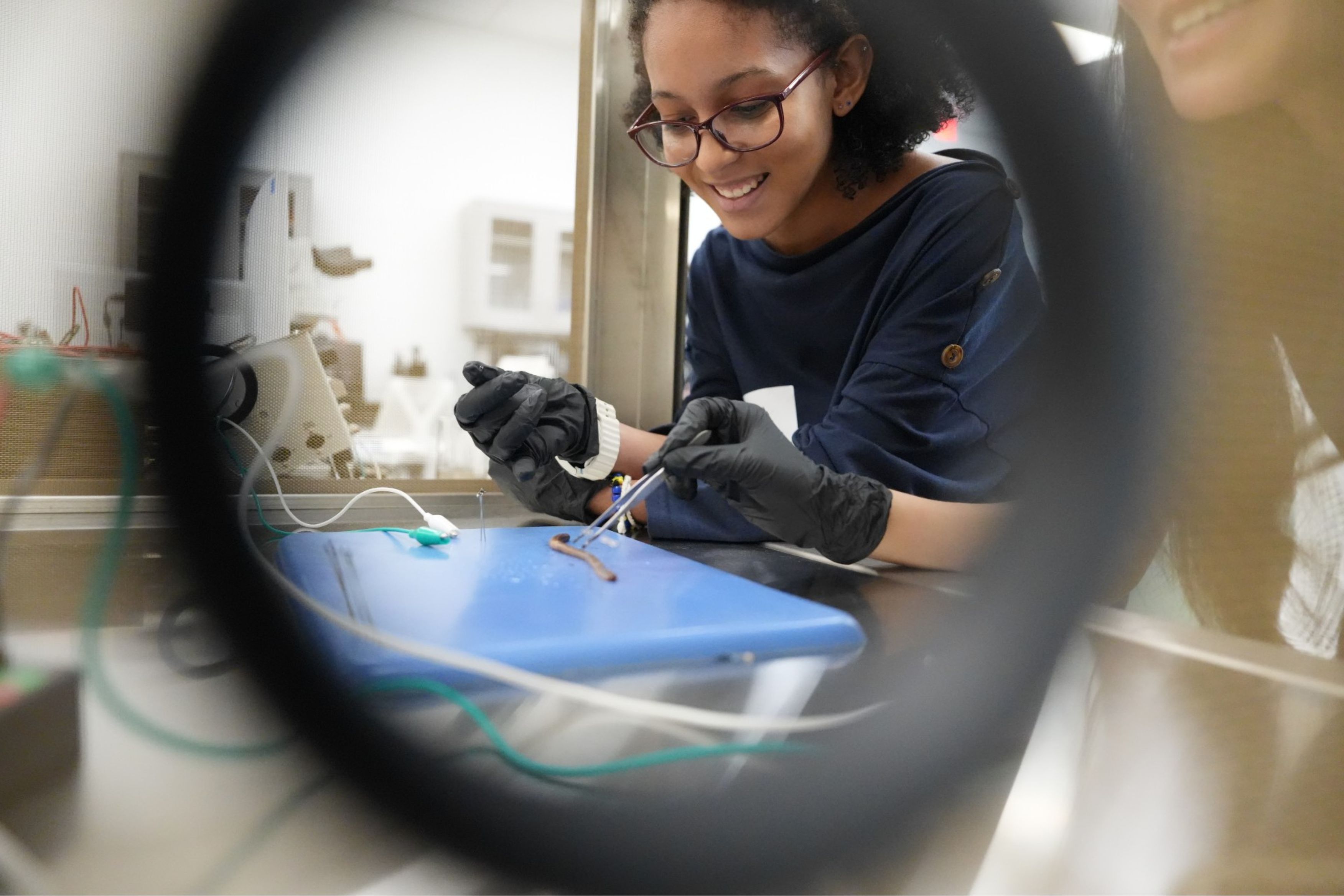
This study was conducted within the FAU Lab Schools, a nationally recognized developmental research school located on Florida Atlantic University’s campus. FAU High School operates the nation’s only fully immersive early-college model, where all students pursue both a high school diploma and a bachelor’s degree simultaneously. Students in the Neurophysiology CURE work in partner groups to collect electrophysiology data using invertebrate models, then write scientific journal-style lab reports based on their findings. Participants include advanced high school and undergraduate students with varying levels of scientific writing experience. The course emphasizes authentic research practices, making it an ideal setting to investigate how collaborative writing influences students’ scientific communication, learning, and the development of student identity as emerging scientists.
Figure 1. Neurophysiology CURE students learn electrophysiology techniques and scientific communication over the course of a semester.
For researchers and professionals in the field of science, collaborative writing is a necessary skill. Projects are often completed across multiple individuals, research teams, and institutions, reflecting the interdisciplinary and global nature of modern scientific inquiry. Collaborative writing enables efficient sharing of expertise, fosters cross-disciplinary problem-solving, and is crucial for success in large-scale research initiatives (Cahusac de Caux & Pretorius, 2024; Francis et al., 2025; Moxie et al., 2025).
Course-based undergraduate research experiences (CUREs) are recognized as high-impact educational strategies, designed to immerse students in authentic research processes while they acquire technical laboratory skills and learn how to conduct independent investigations within a course setting. CUREs are distinctive because they offer broader access to undergraduate research, reaching populations that may not normally benefit from traditional research opportunities (Duboue et al., 2022; Parsons et al., 2021).
Extensive research demonstrates the benefits of high-impact practices, such as writing-intensive courses and CUREs, on student learning outcomes; these benefits include enhanced academic performance, increased self-efficacy in scientific skills, and improved technical and communication proficiencies (Leyser-Whalen & Monteblanco, 2022). For example, writing-intensive pedagogy and research-based course design improve critical thinking, information literacy, and engagement, particularly for first-generation and underrepresented minority students (Moxie et al., 2025, Parsons et al., 2020, and Ndoye, 2024).
One major part of the process of research is communicating results to a broader population. This can include presenting research findings as a talk or poster presentation at a state, national or international symposium, but this can also include publishing original research in a scientific journal. While there is extensive research on the benefits of high impact practices like writing-intensive and CUREs courses on student learning, such as improved academic and technical skills (Appel et al., 2024), there is little research on the impact of collaborative writing within the science CUREs setting.
Despite robust evidence highlighting the value of CUREs and writing-intensive experiences, there has been relatively little investigation into the specific impact of collaborative writing within science-based CURE settings. This gap in knowledge demonstrates a need for research focused on how collaborative writing assignments affect both student learning and research quality in CURE courses. This project aims to better elucidate the benefits and/or disadvantages of employing collaborative writing assignments in a CUREs setting, probing their role in fostering scientific communication, teamwork, and professional preparation.
Research Methods
Description of Course Structure: Dual-enrolled high school students in the upper-level Neurophysiology CURE course learn the technical skill of electrophysiology using invertebrates over the course of a semester. The class has a course-based undergraduate research experience (CURE) course structure where students learn a technique and then apply that skill to develop their own unique question that they will then design an experiment to collect and analyze data, coming to an evidence-based conclusion regarding their question. The course not only focuses on the technical skill of electrophysiology, but teaches students the process of research, including scientific communication.
The course is set up so that students work in partner groups to collect electrophysiology data and complete a series of experiments. Students then must write their findings in the format of a scientific journal article. The course not only teaches students the technical skill of electrophysiology, but it also teaches them the process of research as well as scientific communication. Prior to engaging in scientific writing, students will be given a pre-course survey to assess their baseline comfort level with scientific writing and their attitudes toward writing in general (see Appendix for surveys). For the first lab report, students write the report individually and receive feedback. This is intentional so that students familiarize themselves with the entire scientific writing process and receive personalized feedback before engaging in collaborative writing so that each student, regardless of individual comfort levels, gains experience with the entire writing process. Students then engage in collaborative writing. A short survey is given after each submission where students indicate what each individual contributed to. After students finish collaboratively writing the next 4 reports, students will be asked to complete a post-survey that assesses their attitudes toward writing, their experiences writing collaboratively, reflections on their writing, and their perceived learning gains. Samples of student writing and individual rubrics will also be compared between individual and collaborative writing assignments.
Results
This study examined student perceptions of collaborative writing within an upper-level Neurophysiology Course-based Undergraduate Research Experience (CURE) enrolling dual-enrolled high school students at Florida Atlantic University. The course integrated authentic scientific research practices, including electrophysiology experimentation, data analysis, scientific writing, and poster presentation, with students completing both independent and collaborative scientific reports.
Student Background and Prior Experience
Prior to the course, most students reported limited experience with scientific journal-style writing. Approximately 65% of students indicated they had not previously written a scientific lab report in journal article format, while only 35% reported prior experience. Students also entered the course with varying levels of confidence in scientific writing and collaborative work. Although many students described themselves as “somewhat comfortable” with scientific writing and peer collaboration, relatively few identified as “extremely comfortable,” suggesting substantial room for growth in both domains.
Pre-Course Perceptions of Collaborative Writing
Analysis of pre-course open responses revealed that students initially conceptualized collaboration primarily as a logistical process centered on workload division and coordination.
The dominant anticipated strategy was equal division of work by sections or workload (72%), with students frequently describing splitting the report into sections such as introduction, methods, results, and discussion. Communication and planning also emerged as prominent themes (50%), with students anticipating the need for scheduled meetings, timelines, and coordinated deadlines. Nearly half of students (44%) expected to divide work according to individual strengths and understanding of content. Less frequently mentioned were peer review/editing (28%) and role rotation (11%), suggesting that students initially viewed collaborative writing more as task-sharing than as a co-constructive learning process.
When discussing anticipated benefits, students most commonly identified reduced workload and increased efficiency (56%), followed by exposure to new perspectives and idea exchange (50%), peer-supported learning (44%), and peer review/improved quality (39%). Students also anticipated gains in communication and teamwork skills, though these were mentioned less frequently (22%).
“The workload is greatly lifted and new, fresh eyes are able to look over your writing.”
“Being able to bounce ideas and get fresher perspectives.”
|
Theme |
% |
Count |
|
Equal division (sections/workload) |
72% |
13 |
|
Communication & planning |
50% |
9 |
|
Strength-based division |
44% |
8 |
|
Time management (meetings/deadlines) |
28% |
5 |
|
Peer review/editing |
28% |
5 |
|
Rotation of roles |
11% |
2 |
Figure 1. Themes of student open responses to the prompt: What strategies did you and your partner use to divide the work?
Students also anticipated several challenges associated with collaborative writing. The most common concerns included time management and scheduling conflicts (44%), communication challenges (39%), workload coordination (33%), and integration of ideas into a cohesive report (33%). Students additionally expressed apprehension about interpersonal dynamics, including discomfort with critique and differing work styles (22%).
Despite these anticipated challenges, most students (71%) reported a preference for collaborative writing in future courses prior to engaging in the collaborative experience itself. Students largely justified this preference through expectations of efficiency, shared learning, and workload reduction. Conversely, students that reported that they preferred individual writing (24%) cited obstacles to scheduling, quality or work, and meeting deadlines as reasons for their preference.
“I've always preferred doing individual work over group/partnered work because I know my schedule, can rely on myself to get things done on time, and I know the quality of my work and am completely comfortable editing my own work harshly.”
Quantitative Changes in Scientific Writing Confidence and Perceptions
Likert-scale analyses demonstrated substantial positive shifts in students’ confidence in scientific writing and perceptions of collaborative writing over the duration of the course.
Students reported notable gains in confidence related to scientific writing structure and communication. The largest increase occurred for the statement, “I feel confident that I can structure a scientific paper,” which increased from a pre-course average of 3.0 to a post-course average of 4.83 (+1.83). Additional gains were observed in:
- Providing background and rationale (+1.33)
- Discussing scientific significance (+1.17)
- Understanding course concepts through writing (+1.00)
- Improving scientific communication skills through collaboration (+1.17)
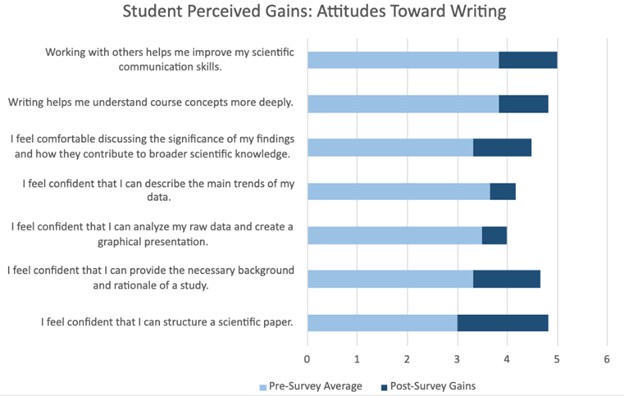
Figure 2. Student-reported perceived gains comparing Pre- vs. Post-survey responses on their attitudes and confidence toward activities related to scientific research and inquiry.
More modest gains were observed in graphical analysis and interpretation of data trends (+0.50 each), suggesting students may have entered the course with relatively stronger prior confidence in technical data analysis compared to scientific communication.
Students also reported positive perceptions of the process of collaborative writing itself. Responses indicated increases in agreement that:
- Collaborative writing improved understanding of the scientific writing process (+0.83)
- Collaborative writing improved understanding of neurophysiology concepts and data (+0.67)
- Collaborative writing encouraged deeper engagement with electrophysiology data (+0.67)
- Collaborative work improved communication of scientific ideas with peers (+0.83)
Students additionally maintained a high agreement that collaborative writing reduced workload and improved error detection and overall report quality.
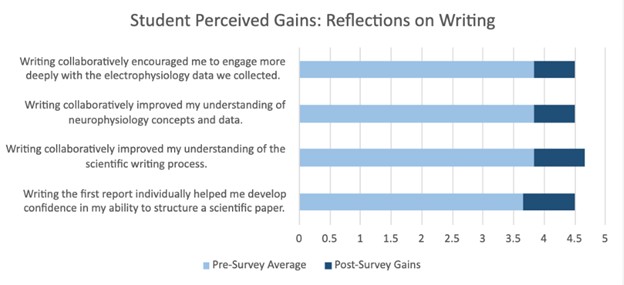
Figure 3. Student-reported perceived gains comparing Pre- vs. Post-survey responses reflecting the process of collaborative writing.
Post-Course Experiences of Collaborative Writing
Post-course qualitative responses demonstrated a shift from procedural understandings of collaboration toward more strategic and cognitively oriented perspectives.
The dominant post-course collaborative strategy became strength-based division of labor (64%), indicating that students increasingly allocated responsibilities according to perceived expertise and skill. Students frequently described one partner focusing on figures and data analysis while the other emphasized written sections such as introductions or discussions. Hybrid approaches combining division of labor with shared review and collaboration were also common (36%), reflecting more sophisticated collaborative structures than those anticipated pre-course.
Students identified several major benefits of collaborative writing following the course including increased efficiency and reduced workload (64%), peer-assisted learning and deeper understanding (43%), strength-based contribution (43%), and peer feedback and improved quality (29%).
“…having multiple people writing the same document allowed us to check each other’s work.”
“…very beneficial since we are able to help each other understand what we did in the l ab.”
“…to gain unique insights from others, allowing one to create a deeper, more thoughtful piece.”
At the same time, students reported more nuanced and concrete challenges than those anticipated at the start of the course. The most frequently reported post-course challenges included time management and scheduling conflicts (57%), unequal contribution/accountability issues (36%), communication and coordination challenges (29%), and challenges integrating different voices/writing styles and consistency of work (29%). Students frequently discussed logistical barriers, procrastination, and the difficulty of synthesizing independently written sections into cohesive reports. Importantly, several responses highlighted higher-order analytical tensions, such as negotiating interpretations of unexpected electrophysiology data.
Interestingly, when surveyed about their collaborative writing experiences, students did not indicate any gains in collaborative writing increasing the quality of their reports (+0) nor did collaborative writing make it easier to them to identify and correct errors in their writing (+0), however, students did indicate that working collaboratively improved their ability to communicate scientific ideas with peers (+0.83).
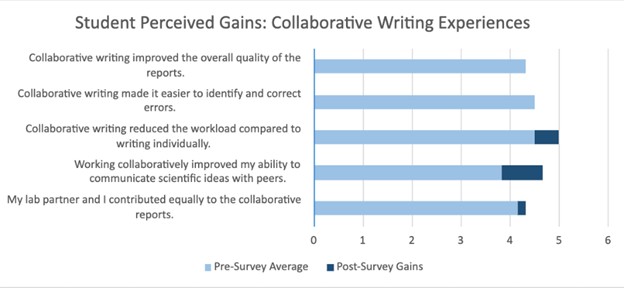
Figure 4. Student-reported perceived gains comparing Pre- vs. Post-survey responses on the collaborative writing experience.
Despite these challenges, students maintained a strong preference for collaborative writing after the course. Approximately 71% of students indicated they would prefer collaborative writing in future courses, while only 14% preferred individual writing and 14% expressed neutrality. Interestingly, the percentage of students that preferred to write individually reduced from 24% to 14% in the post survey and a neutral view on collaborative writing increased from 6% to 14%, while students' preference for collaborative writing was maintained from pre-to post-surveys at 71%. Students continued to identify efficiency, peer support, feedback, and collaborative learning as major reasons for this preference.
Overall Shifts in Student Attitudes Toward Collaborative Writing
Taken together, the findings demonstrate a clear shift in student perceptions over time. Pre-course responses focused heavily on logistical coordination and equitable task division, whereas post-course responses reflected greater emphasis on optimization, strength-based specialization, peer learning, and writing quality. Students also developed a more realistic and experience-based understanding of collaborative challenges, particularly regarding accountability, coordination, and integration of work.
A central tension emerged throughout the data where students consistently described collaborative writing as both highly efficient and logistically complex. Collaborative writing reduced individual cognitive and workload demands while simultaneously introducing challenges associated with coordination, scheduling, and communication.
Teacher-Evaluated Shifts in Student Scientific Writing Abilities
After the process of collaborative writing was complete, student reports were evaluated for evidence of the impact of collaborative writing on students’ conceptual understanding, writing ability, and critical thinking. Comparative analysis of independently written lab reports and collaboratively written lab reports across two upper-level Neurophysiology Course-based Undergraduate Research Experience (CURE) cohorts revealed consistent evidence that collaborative writing supported enhanced scientific reasoning, conceptual integration, disciplinary writing practices, and interpretation of experimental data. While many independently written reports demonstrated strong foundational understanding and scientific communication skills, collaboratively written reports more consistently exhibited mechanistic reasoning to explain data and results, the integration of scientific theory with evidence, more cohesive scientific narratives throughout the report, and more high-order analytical thinking when it came to discussing experimental findings and their significance. Importantly, the observed gains extended beyond grammar or writing mechanics. Collaborative reports demonstrated stronger evidence of authentic scientific thinking and deeper engagement with neurophysiological concepts.
One of the clearest differences between independent and collaborative reports was the increased sophistication of the introductions and theoretical framing in the collaborative reports. For example, one individual's threshold report provided a generally accurate explanation of threshold, excitability, rheobase, and chronaxie, but the writing remained primarily descriptive and focused on defining terms. In contrast, the collaborative refractory period report that the student wrote with their lab partner incorporated substantially deeper mechanistic reasoning, including discussion of sodium channel inactivation, hyperpolarization, orthodromic propagation, and the physiological significance of refractory periods in neuronal signaling. Student writing shifted from merely defining terms, “the threshold is the minimum stimulus intensity required to trigger an action potential and propagate a signal along an axon”, to relating how these concepts fit within the framework of not only the experiment but scientific theory, “as repolarization progresses, Na+ channels start to recover from inactivation while voltage-gated K+ channels stay open, causing the membrane potential to become temporarily hyperpolarized.”
In addition, collaboratively written reports more consistently demonstrated mechanistic interpretation rather than simple trend reporting. For example, one individual report appropriately identified the inverse relationship between duration and threshold voltage and described rheobase and chronaxie values. However, the later collaborative refractory period report written with their lab partner moved beyond simple trend identification and more fully explained why refractory periods occur physiologically, explicitly connecting sodium channel inactivation and potassium channel recovery to neuronal excitability.
The collaborative reports also demonstrated improved integration of evidence and scientific narrative. While scientific writing follows a formula, introduction, hypothesis, methods, results, discussion, and references, a narrative story of what is known, identifying specific gaps in knowledge, asking a question, designing an experiment to answer this question, the results, and how those results fit into the context of what is known and their significance is told using this format. In several individual reports, sections appeared more compartmentalized with little connection between sections or relation back to information that was previously noted in the report. For instance, one independently written report clearly described procedures and hypotheses but often separated conceptual explanations from the interpretation of results. In contrast, the collaborative reports more consistently maintained a cohesive scientific narrative, repeatedly tying methodological choices directly back to physiological reasoning and hypotheses about refractory dynamics. The collaborative reports also appeared to demonstrate stronger engagement with difficult or ambiguous data interpretation. For example, one collaboratively written report discussed variability in refractory period measurements and acknowledged limitations in detecting relative refractory entrances across some trials. Rather than ignoring inconsistent findings, the report attempted to interpret and contextualize them.
Although collaborative reports generally demonstrated stronger scientific writing, several important caveats emerged. Certain independently written reports were already exceptionally strong. Some individually written reports demonstrated strong conceptual understanding, clear scientific organization, and sophisticated use of terminology, and highly detailed explanations. In these cases, collaborative writing appeared to refine and expand existing strengths rather than fundamentally transform writing quality. Additionally, few collaborative reports showed subtle inconsistencies in writing style, sentence complexity, or terminology usage across sections, potentially reflecting merged authorial voices. While these inconsistencies were relatively minor, they suggest that integrating independently written sections into a cohesive narrative remained an ongoing challenge, consistent with students’ survey reflections about integration and consistency.
Implications
The findings from this study largely support existing literature on the benefits of both Course-based Undergraduate Research Experiences (CUREs) and writing-intensive pedagogies, while also extending this work by specifically examining collaborative writing within a science-based CURE setting. Prior literature suggests that collaborative and writing-intensive learning environments can improve scientific communication, critical thinking, engagement, and self-efficacy in STEM students, particularly within authentic research experiences (Appel et al., 2024 Kim, C. et al., 2023; Quitadamo, I.J. and Kurtz, M.J., 2007). The findings from this study confirm many of these claims. Students demonstrated increased confidence in scientific writing, stronger understanding of neurophysiology concepts, and greater engagement with electrophysiology data following collaborative writing experiences. Additionally, comparative analysis of independently and collaboratively written reports demonstrated that collaborative writing often resulted in more sophisticated mechanistic reasoning, stronger integration of scientific evidence, and deeper interpretation of experimental findings.
Importantly, this study also helps clarify how collaborative writing may support learning in STEM CURE environments. The strongest gains observed were not simply improvements in grammar or formatting, but rather improvements in higher-order scientific thinking. Collaboratively written reports more consistently demonstrated mechanistic explanations, integration of scientific theory and evidence, cohesive scientific narratives, and deeper analytical interpretation of data. These findings support social constructivist perspectives on learning, suggesting that collaborative writing functions as a process through which students co-construct scientific understanding through dialogue, revision, and shared interpretation. In this way, collaborative writing may help students move beyond simply reporting observations toward engaging in authentic disciplinary reasoning that is more characteristic of practicing scientists.
At the same time, several findings complicate assumptions within the literature that collaboration automatically improves writing quality or learning outcomes. While students overwhelmingly described collaborative writing as beneficial for efficiency, peer learning, and communication, students did not report measurable gains in collaborative writing improving report quality or error correction on post-course Likert measures. Additionally, students consistently identified logistical and interpersonal challenges including scheduling conflicts, unequal contribution, accountability issues, communication difficulties, and difficulty integrating multiple writing voices into cohesive reports.
These findings suggest that collaborative writing is not inherently effective simply because students work together. Rather, successful collaborative writing appears to require intentional instructional scaffolding and support. This is particularly important for educators to consider. Many STEM courses incorporate group work, but students are rarely explicitly taught how to collaboratively construct scientific arguments, how to synthesize independently written sections, how to engage in productive peer critique, or how to discuss differing interpretations of data.
The findings from this study suggest that collaborative writing should be treated as a skill that requires instruction and practice, rather than a purely logistical classroom strategy. The findings also suggest that the structure of this course may have been especially important to student success. Students first completed an independently written report before transitioning into collaborative writing. This was intentional so that all students developed baseline familiarity with the complete scientific writing process before distributing responsibilities among partners. For educators, this may indicate that collaborative writing is most effective when paired with opportunities for independent skill development rather than replacing individual writing entirely.
Another important implication is the role collaborative writing may play in preparing students for authentic scientific practice. Modern scientific research is increasingly collaborative and interdisciplinary. Yet many laboratory courses continue to emphasize individually written reports that do not reflect how scientific knowledge is commonly produced in professional settings. The collaborative writing experiences in this study more closely mirrored authentic research environments by requiring students to negotiate interpretations, divide responsibilities, revise shared documents, and collectively communicate scientific findings. As a result, collaborative writing within CUREs may help students develop not only scientific writing skills, but also professional scientific communication, teamwork, and collaborative problem-solving abilities that are essential for future research and STEM careers. Ultimately, these findings suggest several important considerations for future instructional practice and research. Educators implementing collaborative writing in STEM settings should consider incorporating structured peer-review checkpoints, role rotation, accountability measures, collaborative writing and revision sessions among partners, and explicit instruction on co-authoring and scientific communication strategies.
Future work should continue exploring how collaborative writing functions across different CURE models, student populations, and disciplinary contexts. Additional analyses comparing independent versus collaborative report quality, rubric performance, longitudinal development of scientific writing skills, and persistence in STEM fields may further clarify the educational value of collaborative writing within undergraduate and dual-enrollment research environments.
References
Appel, N. T., Tanveer, A., Brownell, S., & Blattman, J. N. (2024). Engaging Undergraduate Students in Course-based Research Improved Student Learning of Course Material. CBE Life Sciences Education, 23(3). https://doi.org/10.1187/cbe.22-05-0096
Cahusac de Caux, B., & Pretorius, L. (2024). Learning together through collaborative writing: The power of peer feedback and discussion in doctoral writing groups. Studies in Educational Evaluation, 83, 101379. https://doi.org/10.1016/J.STUEDUC.2024.101379
Duboue, E. R., Kowalko, J. E., & Keene, A. C. (2022). Course-based undergraduate research experiences (CURES) as a pathway to diversify science. Evolution and Development. https://doi.org/10.1111/ede.12410
Francis, N., Pritchard, C., Prytherch, Z., & Rutherford, S. (2025). Making teamwork work: enhancing teamwork and assessment in higher education. FEBS Open Bio, 15(1), 35–47. https://doi.org/10.1002/2211-5463.13936
Kim C, Preston K Jr, Braga A, Fankhauser SC. Increasing Student Confidence in Writing: Integrating Authentic Manuscript Writing into an Online 8-Week Research Program. J Microbiol Biol Educ. 2023 Mar 30;24(1):e00199-22. doi: 10.1128/jmbe.00199-22. PMID: 37089245; PMCID: PMC10117147.
Leyser-Whalen O, Monteblanco AD. Course-based Undergraduate Research Experiences (CUREs) in General Education Courses. UI J. 2022 Spring, 13(1):36519. Epub 2022 May 2. PMID: 36633934; PMCID: PMC9830678.
Moxie, J., Dahl, A. A., Fernandez-Borunda, A., & Partridge, H. (2025). Teamwork makes the dream work: group effectiveness in a “Paper Chase” collaborative writing exercise for higher education. Frontiers in Education, 10. https://doi.org/10.3389/feduc.2025.1405449
Ndoye, A. (2024) "High Impact Practices (HIPs) and Student Performance," International Journal of Teaching and Learning in Higher Education, 35(2), Article 11. https://doi.org/10.7771/ 1812-9129.1010
Parsons, J. R. M., Parsons, J. C. M., Kohls, K., & Ridolfo, J. (2021). Piloting an Oral History–Based CURE in a General Education Writing Course for First-Year Students. Scholarship and Practice of Undergraduate Research, 4(2), 27–34. https://doi.org/10.18833/spur/4/2/5
Quitadamo IJ, Kurtz MJ. Learning to improve: using writing to increase critical thinking performance in general education biology. CBE Life Sci Educ. 2007 Summer;6(2):140-54. doi: 10.1187/cbe.06-11-0203. PMID: 17548876; PMCID: PMC1885902.
Appendix
Collaborative Writing in Neurophysiology CURE Surveys
Pre-Survey (administered before Report 1 which is written individually)
Section 1: Background
- Before this course, had you previously written a scientific lab report in the style of a journal article?
____ Yes
____ No
- Prior to this course, how comfortable are you with scientific writing?
1 = Not at all comfortable → 5 = Extremely comfortable
- Prior to this course, how comfortable are you with writing collaboratively with peers?
1 = Not at all comfortable → 5 = Extremely comfortable
Section 2: Attitudes toward Writing
Likert-scale Questions 1 = Strongly disagree → 5 = Strongly agree
- I feel confident that I can structure a scientific paper.
- I feel confident that I can provide the necessary background and rationale of a particular study.
- I feel confident that I can analyze my raw data and create a graphical presentation.
- I feel confident that I can describe the main trends of my data.
- I feel comfortable discussing the significance of my findings and how it contributes to broader scientific knowledge.
- Writing helps me understand course concepts more deeply.
- Working with others helps me improve my scientific communication skills.
Open Response Questions
- What do you anticipate will be the biggest benefit of collaborative writing?
- What do you anticipate will be the biggest challenge of collaborative writing?
Post-Survey (after final collaborative report)
Section 1: Attitudes toward Writing
Likert-scale Questions 1 = Strongly disagree → 5 = Strongly agree
- I feel confident that I can structure a scientific paper.
- I feel confident that I can provide the necessary background and rationale of a particular study.
- I feel confident that I can analyze my raw data and create a graphical presentation.
- I feel confident that I can describe the main trends of my data.
- I feel comfortable discussing the significance of my findings and how it contributes to broader scientific knowledge.
- Writing helps me understand course concepts more deeply.
- Working with others helps me improve my scientific communication skills.
Section 2: Reflections on Writing
Likert-scale Questions 1 = Strongly disagree → 5 = Strongly agree
- Writing the first report individually helped me develop confidence in my ability to structure a scientific paper.
- Writing collaboratively improved my understanding of the scientific writing process.
- Writing collaboratively improved my understanding of neurophysiology concepts and data.
- Writing collaboratively encouraged me to engage more deeply with the electrophysiology data we collected.
Section 3: Collaborative Writing Experiences
Likert-scale Questions 1 = Strongly disagree → 5 = Strongly agree
- My lab partner and I contributed equally to the collaborative reports.
- Working collaboratively improved my ability to communicate scientific ideas with peers.
- Collaborative writing reduced the workload compared to writing individually.
- Collaborative writing made it easier to identify and correct errors.
- Collaborative writing improved the overall quality of the reports.
Section 4: Reflections and Preferences (open response)
- What strategies did you and your partner use to divide the work?
- What do you think were the greatest benefits of collaborative writing in this course?
- What do you think were the greatest challenges of collaborative writing in this course?
- If you had the choice, would you prefer to write lab reports individually or collaboratively in future courses? Why?