Project Rationale
A wide range of digital tools has been developed to support mathematics education, spanning multiple grade levels and content areas. Prominent examples include Prodigy, IXL, Khan Academy, Desmos, and many others. During my master’s program, I was introduced to GeoGebra, an online platform that describes itself as a dynamic mathematics application integrating geometry, algebra, spreadsheets, graphing, statistics, and calculus within a single environment. Owing to its versatility and my positive experiences using it in advanced mathematics courses, I sought to investigate its implementation in the classroom. Specifically, this project aimed to examine GeoGebra’s potential to enhance conceptual understanding in geometry, its usability for students, and its overall academic benefits.
Context
The project was implemented across two Geometry classes: one consisting of eighteen honors-level students and another comprising sixteen dual-enrollment students. The honors cohort included seventeen eighth-grade students and one seventh-grade student, with a gender distribution of twelve females and five males. The dual-enrollment cohort was composed of eleven eighth-grade students, four seventh-grade students, and one sixth-grade student, including six females and eleven males. Although no formal demographic survey was conducted, both classes represented a diverse range of backgrounds, cultures, and life experiences.
Supportive Literature
Children, and adults, love to build and create. Lego building blocks had $11 billion in US sales in 2024 alone (“LEGO Group Delivers Record Results in 2024”). Minecraft, a digital toy/game where users can build and create elaborate worlds, launched in 2009. Over the past sixteen years, the game has sold over 300 million copies, and 62 million people still play it at least once per month (Curry). It goes without saying that allowing students to build may be a practical method for education as well.
Geometry can be a challenging class for students, even those who are otherwise lovers of math. In addition to the myriad of formulas to be memorized, the lack of experimental activities in the classroom lead to lower scores and increased frustration in learning (Puig et al.). Digital activities in the classroom can help with learning by students creating 2D and 3D shapes that can be manipulated, which can assist with the learning theory of situated cognition, which at its most basic level is learning through doing by seeing context.
GeoGebra, a fully digital tool, was created in 2002, the result of combining existing geometry software with established algebra systems. While they claim to have 100 million users globally, it is relatively unknown in the United States (Hohenwarter and Lavicza). GeoGebra allows users to create various components and shapes including lines, angles, circles, parabolas, and countless other two-dimensional objects as well as solids of various types. Measures can be calculated and displayed and as such, various geometric theories can be built and tested in the classroom.
Lastly, while one study was recently conducted in Turkey, it focused on the basic algebraic concept of slope, and consisted of using tools built by others within GeoGebra (Birgin and Uzun Yazıcı). While many such tools exist, the goal of this project was to incorporate students building their own constructions and learning from observation of those.
Results
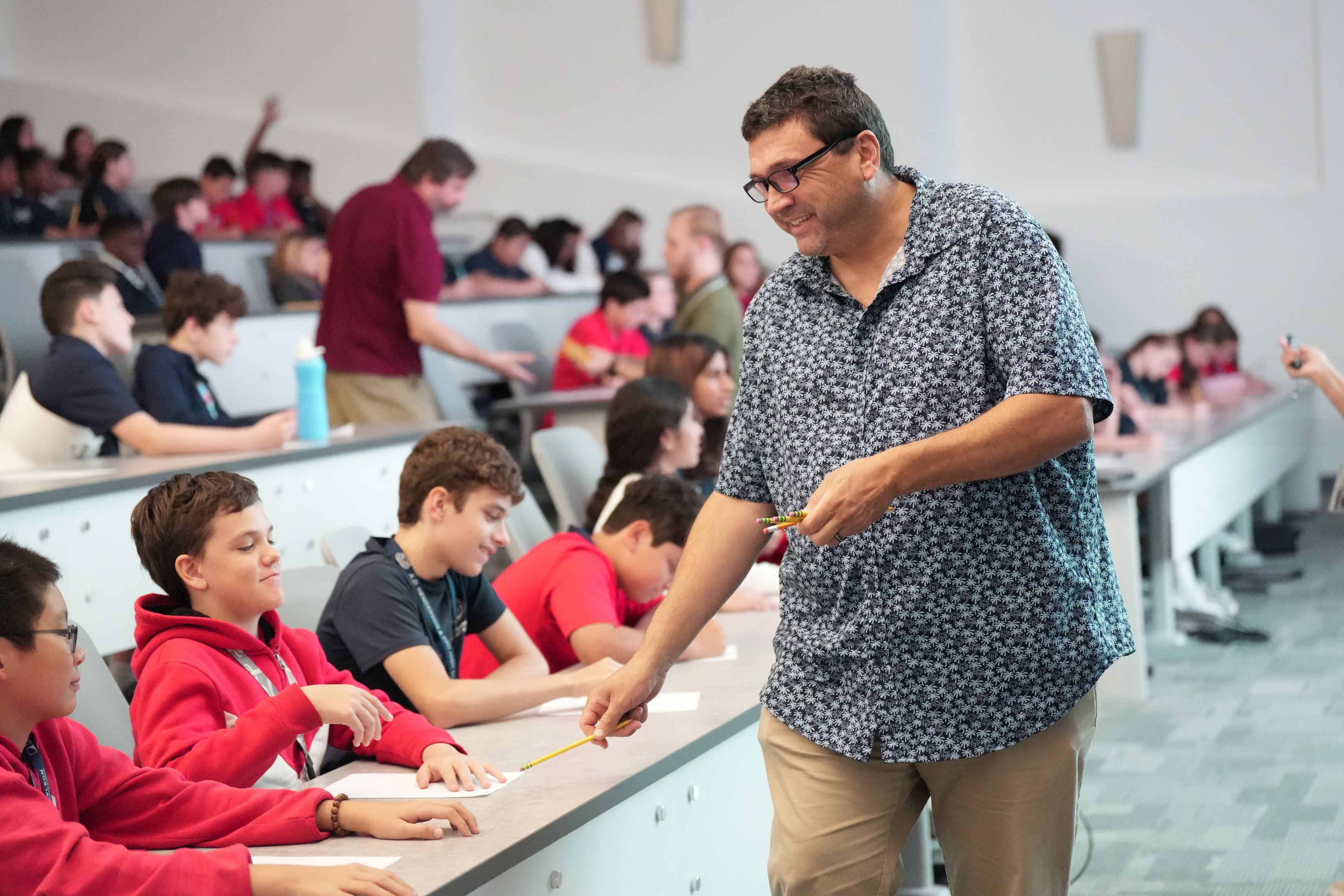
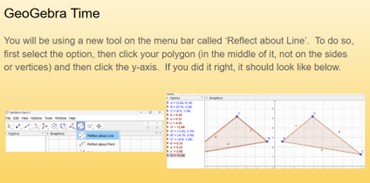
Throughout the past year my geometry students have been given several exercises to complete constructions using GeoGebra. Instructions for the constructions were part of the class instruction broken into several slides. I would walk the room to help students who had technical issues as well as help them experiment with their creations. I followed this up with a survey and solicited their anonymous, honest feedback.
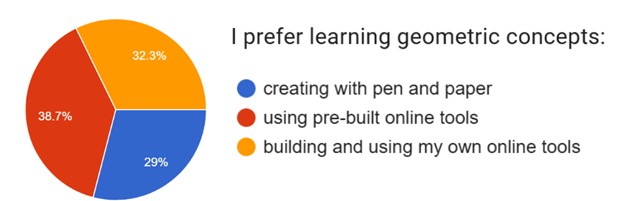
I first asked them to reflect on how they best enjoy learning. My assumption prior to the start of the project was that being able to build tools of their own design in an online environment, similar to Minecraft or Roblox, would appeal to students. The results show that opinions are mixed. It is nearly evenly spread among those who prefer a more hands-on approach when compared to building with digital tools or using prebuilt tools. The results mirror their feedback, particularly highlighting what they learned from the online tools, but wanting to expand more with hand’s on exercises.
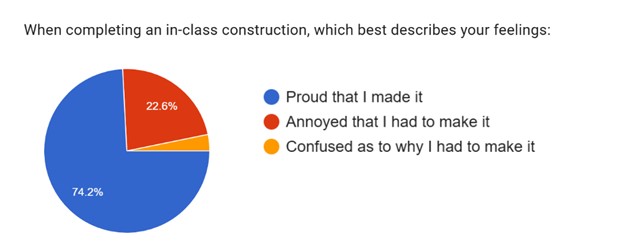
Despite the mixed preferences, students overall felt pride in their creations. While the feedback shared a common frustration when things did not go as planned, when it did work and the students could play with their creation, A common response was that it helped them visualize and experiment with geometric concepts rather than simply looking at static images.
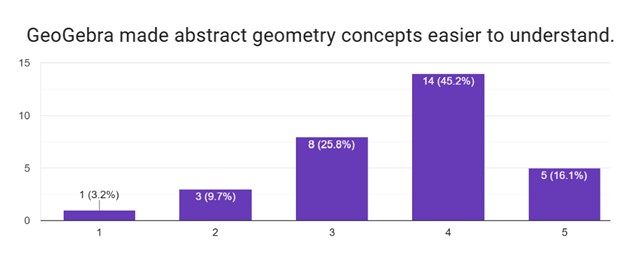
Students were asked to rate on a scale of 1-5, with 5 meaning strongly agree, and 1 meaning strongly disagree, the statement “GeoGebra made abstract geometry concepts easier to understand”. Of the students who participated, 61% either agreed or strongly agreed with this statement. This sentiment corresponds to several comments from statements as it allowed visualization and experimentation with ideas. For the students who have already taken the geometry EOC, several claim that this visualization helped them to be better prepared.
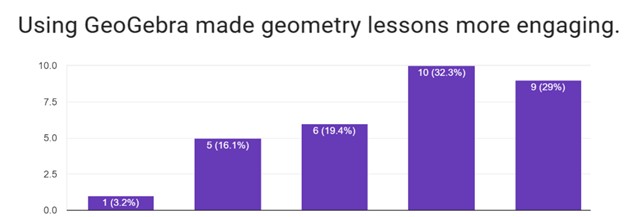
I used the same scale to ask students if GeoGebra made lessons more engaging. Again, 61% agreed or strongly agreed with the statement. The majority shared comments stating that using it was better, in some projects, than using paper. Others felt it was a good use of classtime and found it a creative output. Those who struggled felt that GeoGebra was used too much, was rushed, and was complicated.
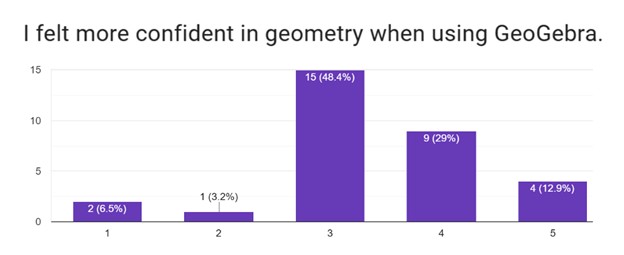
I asked the students if using GeoGebra helped their confidence. In this case, the scores were overall lower. A common theme in responses were that the constructions were too complicated and because of that, it was too hard to follow. While I am there to guide them, as I did during this research, they were able to manage the constructions, but lacked the confidence to build on their own.
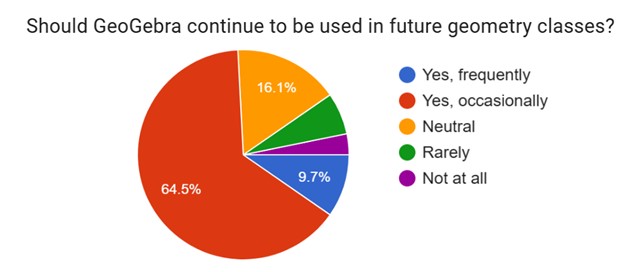
Lastly, I asked if GeoGebra use should still be used in the classroom. An overwhelming majority felt that it should continue, even if used somewhat only occasionally. Nearly three-fourths of the students support its continued use in the classroom.
Summarizing my findings, there is no question that GeoGebra belongs in the classroom in some aspect. There was an overall positive response to engagement and understanding, while confidence was not as strong. The students appreciated what GeoGebra offers, but that in the future it should be tempered with more traditional activities.
Implications
Student survey data indicate that GeoGebra supports engagement and conceptual understanding in Geometry. A majority of students agreed that GeoGebra made lessons more engaging and helped clarify abstract concepts. However, confidence ratings were more moderate, with many students reporting neutral feelings. Additionally, while most students support continued use, they prefer it be used occasionally rather than frequently.
These findings suggest that GeoGebra is most effective as a teacher-directed visualization tool rather than a primary student construction platform. While dynamic exploration enhances understanding, independent construction sometimes led to frustration and reduced confidence.
Next year, I will shift to building GeoGebra constructions myself prior to instruction, allowing students to observe, analyze, and discuss the mathematical relationships being modeled. This approach preserves the visual and dynamic strengths of the software while reducing cognitive overload. Students who demonstrate interest will be offered optional opportunities to modify or extend constructions independently. This balanced model aims to maintain engagement and conceptual clarity while strengthening student confidence and reducing frustration.
References
Birgin, Osman, and Kübra Uzun Yazıcı. “The Effect of GeoGebra Software–Supported Mathematics Instruction on Eighth‐Grade Students’ Conceptual Understanding and Retention.” Journal of Computer Assisted Learning, 8 Feb. 2021, https://doi.org/10.1111/jcal.12532.
Curry, David. “Minecraft Revenue and Usage Statistics (2020).” Business of Apps, 5 Jan. 2021, www.businessofapps.com/data/minecraft-statistics/.
Hohenwarter, Markus, and Zsolt Lavicza. Gaining Momentum: GeoGebra Inspires Educators and Students around the World.
“LEGO Group Delivers Record Results in 2024.” LEGO.com, The LEGO Group, 11 Mar. 2025, www.lego.com/en-us/aboutus/news/2025/march/lego-group-delivers-record-results-in-2024?locale=en-us.
Puig, Anna, et al. “Children Building and Having Fun While They Learn Geometry.” Computer Applications in Engineering Education, 28 Dec. 2021, https://doi.org/10.1002/cae.22484.