Project Rationale
Immersive experiences are an emerging modality of delivering educational content through sight, sound, and an interactive atmosphere. Immersive experiences blend projection technology with digital animation, interactive components, carefully crafted narration and musical scores to create an exhibit that allows attendees to move freely about the space while taking in larger-than-life educational content projected on the walls and floors. PBS South Florida created an immersive exhibit space in their Boynton Beach studio where they host free field trips for K-12 institutions and free professional development for teachers aligned with their current immersive exhibit.
Project Context
WXEL PBS South Florida is exploring immersive exhibits as a new educational modality. Offered as a ticketed event to the public and a free field trip for schools, the immersive experiences use cutting edge technology to meld projection technology, digital art, music and history to create a unique, memorable exhibit. PBS partnered with Lindsey Wuest of FAU Lab Schools to introduce teachers to this new modality at a series of free Saturday professional developments. PBS is looking to refine their immersive experiences and improve the exhibits for students via the feedback of educators, which was the inspiration for the qualitative study. This study focuses on participants in a professional development on Saturday, September 27, 2025 (55 attendees) and Saturday, January 24, 2026 from 11am-1pm (52 attendees).
The “Pharaohs of Egypt” immersive experience consisted of massive projections featuring a narrated timeline, ancient Egyptian art, mythology, god and goddesses, monumental structures and tomb paintings. The duration of the immersive experience was about an hour, with 15 minutes in one room and 37 minutes in a second room. Accompanied by music, text and sound effects, the immersive exhibit allowed visitors to move about the space and read educational content projected in a designated corner of the room.
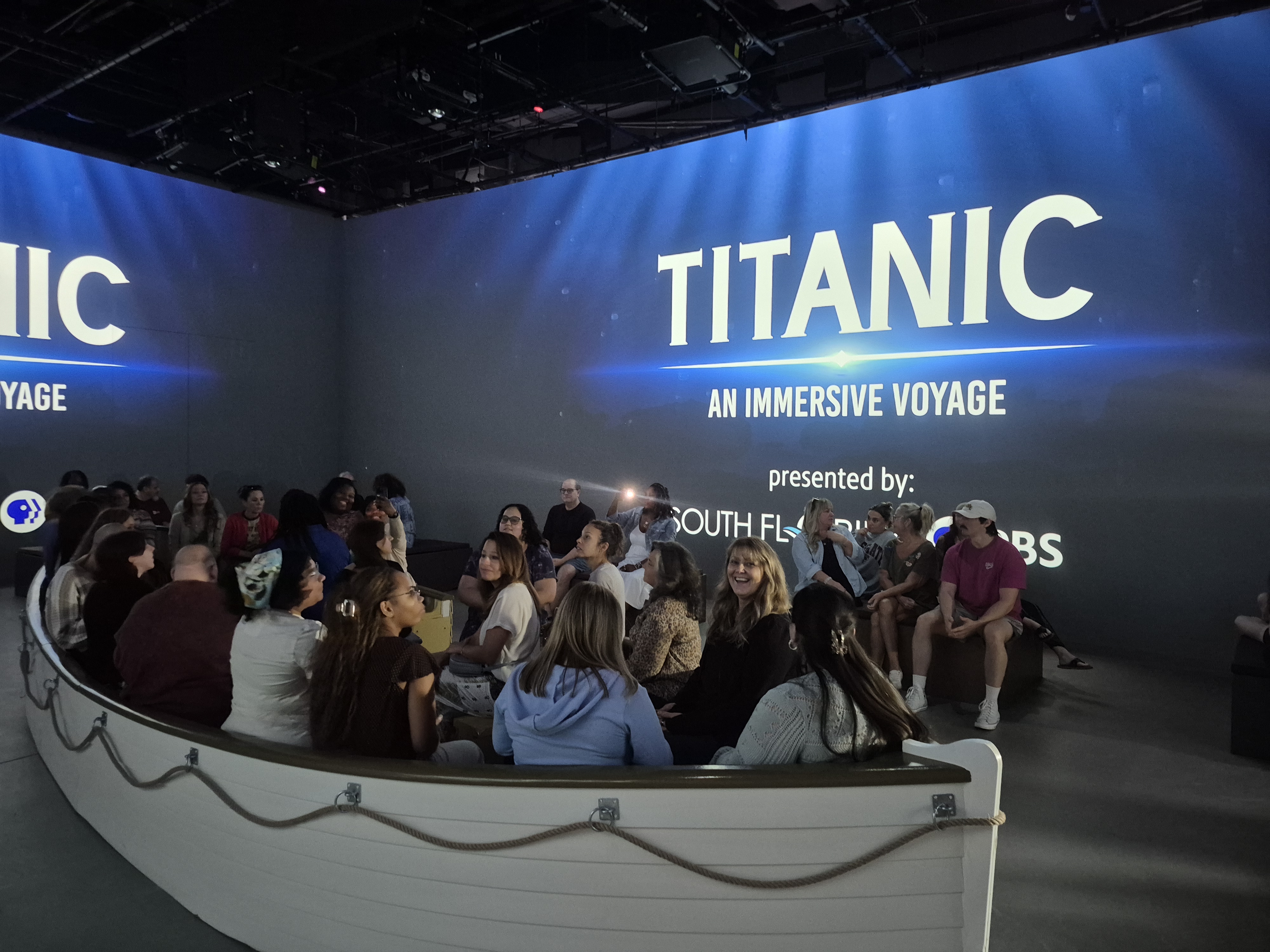
During “Titanic: An Immersive Voyage” attendees entered the room and were seated in models of Titanic's lifeboats. The walls came to life with Titanic’s story- from its construction in Belfast, to a tour of the inside to its final moments and icy, watery demise. Accompanied by sound effects, music and real text from telegrams, attendees learned about this somber event and its historical significance. After the exhibit, participants attended a professional development session about integrating topics from the immersive exhibit in the classroom using art projects. The professional development shared various ways to integrate the visuals and themes of the immersive experience into a K-12 classroom. Participants were presented with a unit of art based projects along with resources created specifically to align with the immersive experience. Participants were invited to schedule their students for a free field trip to the Pharaohs of Egypt immersive exhibit and to the Titanic: An Immersive Voyage immersive exhibit.
Supportive Literature
Immersive exhibits are becoming more popular as technology advances and become more accessible. It is important to note that “immersion is a subjective phenomenological experience of partaking in an all-inclusive experience.” (Mystakidis, S., & Lympouridis, V., 2023). Virtual reality (VR) is a type of immersive experience, however not all immersive experiences involve VR. In this study, immersive aspects include projections, lighting, sound, a closed environment and a group setting. The immersive experience is an open room with optional bench seating at the center of the space. Attendees are invited to move freely about the space and are not wearing headsets or audio devices. All visuals occur on the four walls and floor of a large closed room. The lighting is dim, the projections are monumental and the audio is comfortably loud. It is important to note that “the more a virtual immersive experience is based on design strategies that combine actional, symbolic, and sensory factors, the greater the participant's suspension of disbelief that she or he is “inside” a digitally enhanced setting.” (Dede C., 2009).
Immersive exhibits make educational content more accessible to communities. “Immersive technologies allow the sensation of rare, precious or vulnerable objects or sites that would otherwise not be accessible for a large audience of museum visitors. Hence “interaction with objects is not necessarily based only on direct sensorial observation, but also on technological representations.” (De Freitas et al., 2010).
It is important to consider the financial aspects of immersive exhibits. PBS was defunded by the government, prompting them to look for new streams of revenue. Immersive experiences have allowed them to bring in profits while still aligning with their goal of public education. It is important to note that all field trips and teacher professional developments are offered free of charge. However, “there is sometimes a thin line between these non-profit institutions, and commercial exhibits which engage with related activities but still adopt a more limited focus.” (Smets, W. & Euser, V., 2025).
Educators must consider which aspects of the exhibit cater to educational purposes and which cater to entertainment.
Research Methods
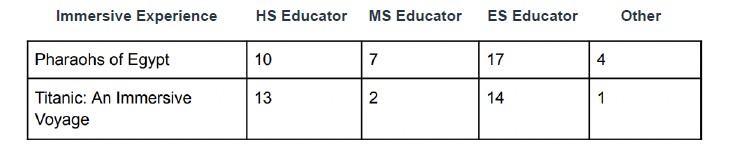
After each immersive experience and aligned professional development, attendees were asked to complete a survey about the immersive experience and the content of the PD and resources presented. At "Pharaohs of Egypt,” the surveys were given on paper. Results were transcribed into a spreadsheet. 44 responses were received out of 55 attendees. At “Titanic: An Immersive Voyage” the survey was given digitally via a QR code. 30 responses were received out of 52 attendees. The same questions were asked in each survey.
Attendees were a mix of K-12 educators from varying school settings, grade levels and subjects. Levels of experience ranged from less than one year of teaching to more than 25 years. Educators were from Broward County Schools, Palm Beach County Schools, Miami-Dade County Schools and FAU Lab Schools. Attendees were invited via an email list of workshop attendees from the Stiles Nicholson STEM teaching academy and word of mouth. Most educators attended alone, while a few educators attended with colleagues from their school.
Attendees who brought their classes back for a field trip were asked to participate in a focus group held on Zoom. The data was transcribed using AI tools. Responses were coded into categories: student perceptImmersivion of immersive experience and activities presented in the PD, teacher perception of immersive experience and feedback for improvement. A field trip of 48 6th and 7th grade students was observed and notes recorded in a teacher research journal.
Results
The findings of this study suggest that educator perceptions of immersive exhibits and accompanying professional development were overwhelmingly positive. 80.9% of attendees reported that the immersive experience aligned “Perfectly” or “Well” with their existing curriculum, while an additional 16.7% reported the exhibit was “Somewhat” aligned. Teachers consistently identified strong connections to history/social studies, visual arts, science, and interdisciplinary instruction. Frequently referenced themes included “world history,” “cross-curricular,” “visual arts,” and “critical thinking.” One participant described the exhibit as “teaching across subject areas,” while another noted the importance of “connecting multiple disciplines to art…art is everything.”
Educators also responded positively to the accompanying professional development and standards-aligned projects connected to reading, science, and art. Teachers appreciated opportunities to extend learning beyond the field trip experience through inquiry-based and hands-on activities.
When asked about age appropriateness, 50% of participants found the content perfect for their age group and 27.3% found it mostly appropriate. However, 18.2% found the content somewhat advanced and 4.5% considered it inappropriate for their students. Concerns centered on reading levels and background knowledge requirements for younger learners, particularly in exhibits such as Titanic and Pharaohs.
The most common recommendation involved increasing accessibility and interaction. Teachers repeatedly requested “hands-on activities,” “interactive stations,” and “physical interactive objects,” with over 70% of responses mentioning tactile learning opportunities. Participants also requested subtitles, printed guides, headphones for sensory-sensitive students, and quiet areas for students with ASD. One educator asked, “Do you have any headphones to reduce volume for students w/ sensory sensitivity?”
A limitation of this study is that the sample consisted only of educators who voluntarily attended the immersive experience and professional development, which may have resulted in more favorable perceptions overall.
Implications
The findings of this study support existing literature suggesting that immersive learning experiences increase engagement and promote interdisciplinary learning when paired with intentional instructional support. Teachers perceived immersive exhibits as valuable educational tools because they connected history, visual arts, science, literacy, math, and critical thinking within one experience. The accompanying professional development also reinforced research emphasizing the importance of curriculum-aligned resources that help teachers extend learning into the classroom.
At the same time, the findings highlight important considerations for educators and exhibit designers. Teachers consistently noted that some exhibit themes, including Titanic and Pharaohs, contained reading levels and concepts that were too advanced for younger students. This suggests that immersive exhibits should include differentiated materials, simplified text options, and scaffolded supports for elementary learners.
The study also emphasizes the importance of accessibility and inclusion. Educators recommended subtitles, printed text guides, sensory-friendly accommodations, and headphones for students with ASD or sensitive hearing. These findings suggest that immersive experiences should be designed with diverse learners in mind rather than assuming all students can process information through projections and sound alone.
Finally, teachers repeatedly requested more artifacts, replicas, and hands-on learning opportunities. While immersive technology was viewed positively, educators believed students benefit most when digital experiences are paired with tactile, interactive learning that deepens understanding and engagement.
References
De Freitas, S; Rebolledo-Mendez, G; Liarokapis, F; Magoulas, G; Poulovassilis, A. (2010). ‘Learning as immersive experiences: Using the four-dimensional framework for designing and evaluating immersive learning experiences in a virtual world’. British Journal of Educational Technology 41 (1) : 69–85, DOI: http://dx.doi.org/10.1111/j.1467-8535.2009.01024.x
Dede C. (2009). Immersive interfaces for engagement and learning. Science (New York, N.Y.), 323(5910), 66–69. https://doi.org/10.1126/science.1167311
Mystakidis, S., & Lympouridis, V. (2023). Immersive Learning. Encyclopedia, 3(2), 396-405. https://doi.org/10.3390/encyclopedia3020026
Smets, W. & Euser, V. (2025) “A comparative case study of two immersive learning experiences in museums”, History Education Research Journal. 22(1). doi: https://doi.org/10.14324/HERJ.22.1.1