Project Rationale
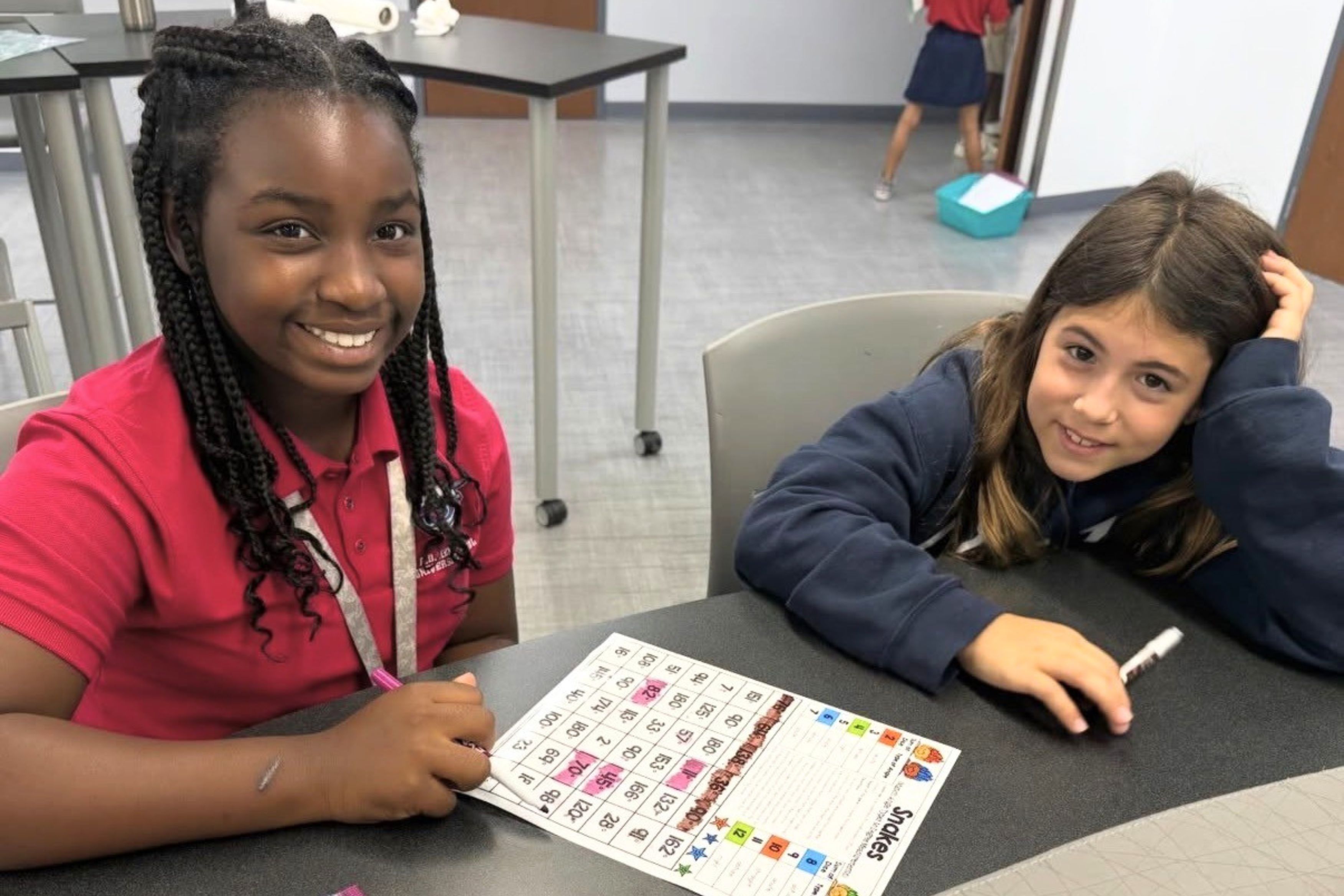
Small group instruction has become an integral part of education and is widely used to help target certain skills based on a student’s learning needs. Although there is research that shows small group instruction can help build a deeper understanding (Jayantika et al., 2025), many students develop negative perceptions of being placed in these groups. Negative perceptions create barriers, disrupting student engagement, and ultimately limiting potential growth. This project investigates how “strategic grouping” in math instruction can reduce stigma and improve students’ views of small group learning. The findings will help teachers create more supportive, inclusive learning environments and strengthen instructional practices in mathematics education. The research question in the study is to investigate to what extent does the strategic structuring of math groups change students’ negative perception of small group instruction?
Project Context
This study took place at A.D. Henderson University School & FAU High School, a public research school located in Boca Raton, Florida. This school is one among few lab schools in the state, servicing students from kindergarten to 12th grade. The participants in this study included 4th grade students from three classrooms. A total of 19 students reported that they had negative perceptions about small group instruction and were chosen as the focus group for this study. This group consisted of 12 female students and 7 male students.
Supportive Literature
Research on small group math instruction suggests that students’ perceptions are shaped by prior experiences, group structure, and teacher influence. While some students view small groups as opportunities for collaboration and support, others associate them with stigma and low ability. Daley and Rappolt-Schlichtmann (2018) explain that “individual perceptions of stigmatization… are not uniform,” meaning students respond differently to small group placement. These perceptions can affect motivation, participation, and self-efficacy in mathematics.
Some studies show that positive small group experiences are connected to peer support and reduced anxiety. Siller and Ahmad (2024) found that collaborative learning environments can improve students’ perceptions of mathematics by creating a supportive atmosphere. However, when small groups are primarily used for remediation, students may feel labeled as “struggling,” leading to disengagement and lower confidence (Elmassah et al., 2020). These findings demonstrate that the way groups are structured and presented can strongly influence student attitudes.
The literature also presents mixed findings regarding grouping strategies. Some researchers support homogeneous grouping because it can improve engagement and problem-solving skills, while others argue that heterogeneous or random grouping reduces stigma and increases participation (Jayantika et al., 2025; Fletcher & Dise, 2025). Flexible grouping has been suggested as a balanced approach because it responds to students’ changing needs while avoiding fixed labels.
Teacher language and attitudes also play an important role in shaping perceptions of small groups. Teachers who promote growth, inclusivity, and positive expectations can help students view small group instruction as an opportunity rather than a punishment. Fletcher and Dise (2025) found that the language teachers use to describe groups influences how students interpret their placement. Overall, the literature suggests that reducing negative perceptions of small group instruction requires careful attention to grouping practices, classroom experiences, and teacher communication.
Research Methods
|
|
Timeline |
|
Month 1 |
● Administer Pre-Assessment Survey to all students |
|
Months 2-5 |
● Vary grouping approach throughout the months |
|
Month 5 |
● Administer Post-Assessment Survey to students with initial negative perception |
|
Month 5 |
● Analyze data, look for patterns, themes |
Data Collection
Students were given a pre-assessment survey before the intervention to determine the focus group and see the initial perceptions of math small groups. Exit ticket surveys were used during the intervention. This helped us get detailed feedback about the effectiveness of the practices being put in place. Qualitative data was also collected through teacher journals documenting student behaviors, statements, and engagement during small group instruction. A post- assessment survey, mirroring the pre-assessment survey, was given at the end of the study. This data was then quantified to measure changes in perception from beginning to end. At the end of the study, student interviews were conducted to retrieve personal statements and testaments about small group practice throughout the year.
Results
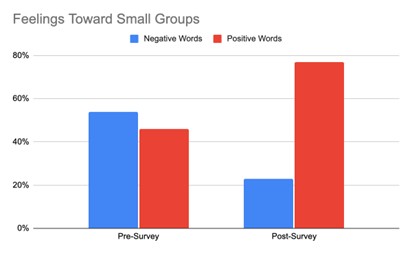
The first important finding was the change in students' emotions toward small group instruction. In the initial survey, five students selected that they felt “nervous” or "embarrassed" about working with the teacher in a small group setting. This shows that these students initially viewed small group instruction as something that was uncomfortable or negative. However, the post survey showed a large shift in those same students' perceptions. All of those students selected positive words to describe how they felt about small group instruction. These words included feeling “thankful”, “excited”, and “happy”. One student even shared, “Even if I don’t feel like I need to go, I want to go because it is fun and more practice.” This change was also documented among the entire group. Almost 80% of students used positive words to describe how they felt about small group instruction by the post survey, compared to only about 45% of students choosing positive words before the research began. These changes show that students began to see small group instruction as a time to grow and deepen their understanding rather than a punishment or something that should be feared.
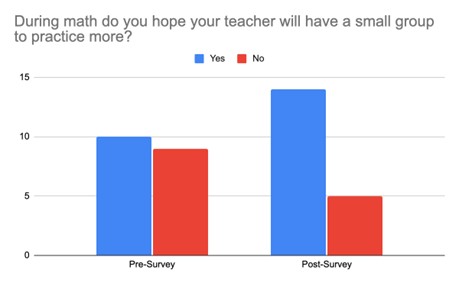
Another important finding was that students found small group instruction to be a preferred way to practice math. In the pre-survey, ten students reported that small group instruction was their favorite way to practice math when they did not feel confident. By the post-survey, 14 students reported that small group instruction was their favorite way to practice math. Students looked forward to the opportunity of being able to work in a small group stating, “Small group is fun because we get to be the teacher and show what we know,” and, "I like small group because we get to play games like bingo.” Students knew that the opportunity to first practice math in a small group setting would then give them the confidence to practice specific skills independently.
Implications
The findings from this study have many important implications for classroom instruction and student learning. First, the way teachers introduce and discuss small group instruction can strongly influence how students feel about participating in it. When small groups are presented as a positive opportunity for growth rather than as a punishment, students are more likely to engage confidently. Teachers should carefully consider the language they use and the classroom culture they create around small group activities.
Second, the types of activities and practice provided during small group instruction also play an important role in shaping students’ perceptions. Students responded more positively when activities were engaging and interactive, like games and becoming the teacher. This shows that teachers should design small group lessons that are hands-on, differentiated, and related to interests. When students see value in the work they are doing, they are more likely to remain focused and develop confidence in their abilities.
Finally, the findings did not support the original concern that students may feel embarrassed or uncomfortable about being grouped with certain peers. Instead, many students reported positive feelings about working with classmates who have similar abilities and learning needs. This suggests that ability-based grouping, when implemented thoughtfully and respectfully, may provide students with a sense of comfort and belonging. Teachers can use this information to create supportive learning environments where students feel understood and capable of participating without fear of judgment.
References
Daley, S. G., & Rappolt-Schlichtmann, G. (2018). Stigma consciousness among adolescents with learning disabilities: Considering individual experiences of being stereotyped. Learning Disability Quarterly, 41(4), 200–212. https://doi.org/10.1177/0731948718785565
Elmassah, S., Bacheer, S. M., & James, R. (2020). What shapes students’ perceptions of group work: Personality or past experience? International Journal of Educational Management, 34(9), 1457–1473. https://doi.org/10.1108/ijem-11-2019-0401
Fletcher, T. S., & Dise, J. J. (2025). Collaborative groups in math: How student grouping strategies can impact math achievement (Graduate Research Paper). University of Northern Iowa. https://scholarworks.uni.edu/grp/4642
Jayantika, I. G. A. N. T., Payadnya, I. P. A. A., & Suryawan, I. P. P. (2025). Group dynamics in mathematics education: Homogeneous vs. heterogeneous group effects on problem-solving skills. Jurnal Pedagogi Dan Pembelajaran, 8(1), 194–203. https://doi.org/10.23887/jp2.v8i1.83498
Siller, H. S., & Ahmad, S. (2024). Analyzing the impact of collaborative learning approach on grade six students’ mathematics achievement and attitude towards mathematics. EURASIA Journal of Mathematics, Science and Technology Education, 20(2), Article em2395. https://doi.org/10.29333/ejmste/14153