Project Rationale
We have observed that students approach mathematics with only calculations in mind, which shows that they are disconnected from applying math in real-world applications. When math is taught in isolation, students often struggle to see its relevance and lose confidence in their abilities. By investigating the impact of optional, real-world, math activities, this study sought to uncover strategies that promote problem-solving, critical thinking, and meaningful connections to students’ lives. The findings informed not only our own instructional practice, but also provided insights for colleagues seeking to design engaging, authentic learning experiences. Ultimately, the research aimed to strengthen mathematics instruction and student confidence across classrooms.
Project Context
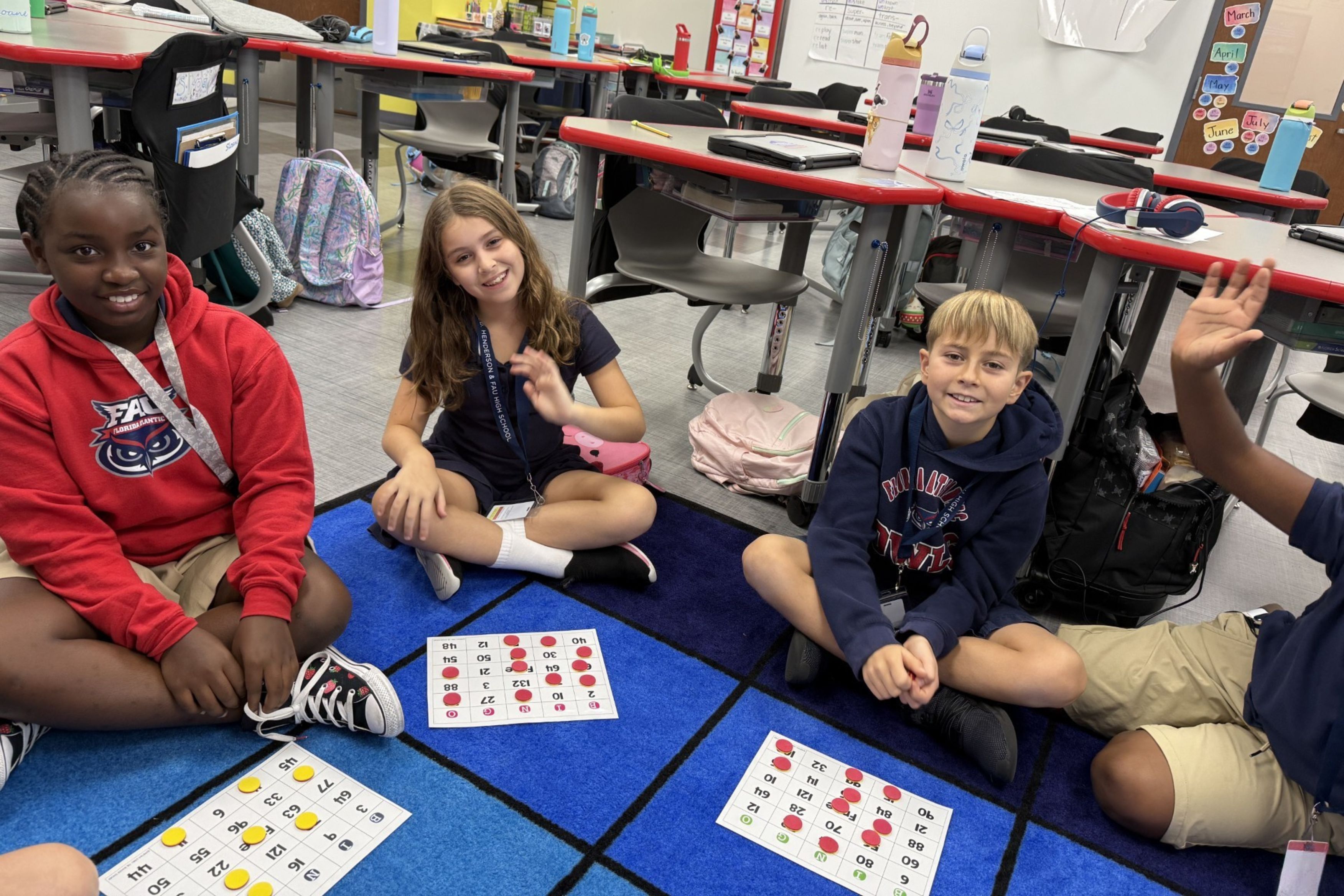
This research was conducted in fifth-grade classrooms at Alexander D. Henderson University School, a developmental research school on the campus of Florida Atlantic University. The study involved 74 students who represented a range of mathematical abilities and learning styles. There were 39 females and 35 males, and of this population nine students had Individualized Education Plans (IEPs).
Participants engaged in real-world math projects, such as budgeting, event planning, and measurement in everyday tasks, designed to align with Florida fifth-grade math standards. Data collection included assessments, surveys, reflections, and teacher observations. By studying students within authentic classroom environments, the project provided valuable insights into how real-world connections influenced performance, problem-solving, and mathematical confidence.
Supportive Literature
Connecting Mathematics to Real-World Contexts
Sujatha and Vinayakan (2023) reviewed research on integrating real-world applications into mathematics instruction to increase student engagement and deepen conceptual understanding. The authors highlighted instructional approaches such as problem-based learning, project-based learning, contextualized lessons, interdisciplinary teaching, and technology integration as effective strategies for connecting abstract mathematical concepts to real-life situations. The review also discussed challenges educators face, including curriculum constraints and the need for professional development, while emphasizing that real-world applications positively impacted student motivation, problem-solving skills, confidence, and long-term academic success. While teachers often focus on calculation and simple word problems, there is a need for students to connect those skills to move beyond calculation and connect math to real-world application. The literature suggests that connecting abstract mathematical concepts to the real-world helps students understand how mathematics connects to their everyday lives.
Student Motivation and Engagement in Mathematics Learning
Schwartz et al. (2025) found that incorporating real-world contexts into mathematics instruction supports student engagement, conceptual understanding, and problem-solving skills. Their findings emphasize the value of applied learning experiences that connect mathematical concepts to authentic situations, such as planning, modeling, and data analysis. When students engage in meaningful, real-world tasks, they are more likely to demonstrate deeper understanding, increased confidence, and improved ability to transfer mathematical knowledge beyond the classroom. This literature suggests that implementing real-world situations into mathematics instruction not only improves student engagement, but also allows students to see how mathematics is used outside of the classroom. Therefore, when students are offered an opportunity to participate in real-world mathematics activities, this will improve their confidence and see additional mathematical relevance beyond the classroom.
Research Methods
At the start of each math unit students were first introduced to mathematical content through direct instruction using the standardized grade 5 district wide mathematics curriculum before being provided with supplemental, real-world extra credit opportunities designed to reinforce the concepts taught each week. These opportunities were intentionally aligned with the unit objectives to help students apply their learning in authentic, meaningful contexts. Students were given the opportunity to participate in real-world extra credit activities that connected math to everyday life. The goal was to see if students felt that these activities would improve their engagement and confidence in their classroom mathematical abilities.
During weeks 1 through 4, students were presented with an extra credit opportunity in week 1 that involved planning a school Fall party. This activity required students to apply multiplication skills to determine quantities of supplies and materials, directly aligning with the instructional focus. Instruction during weeks 1 and 2 centered on multiplying multidigit whole numbers, followed by instruction in weeks 3 and 4 on the multiplication of decimals. At the end of week 4, a confidence survey was administered prior to the assessment to collect student feedback and data related to the instructional experience.
During weeks 5 through 8, students were offered an extra credit opportunity in week 5 that focused on planning a Thanksgiving feast. Students used division skills to calculate food amounts, serving sizes, and seating arrangements, connecting the activity to real-world applications of division. Instruction in weeks 5 and 6 addressed dividing multidigit whole numbers, while instruction in weeks 7 and 8 focused on the division of decimals. An end-of-unit confidence survey was administered at the conclusion of week 8 before the assessment to gather student perceptions and reflections.
During weeks 9 and 10, students were presented with an extra credit opportunity in week 9. Instruction throughout these two weeks focused on adding and subtracting fractions to design a playground for their school. Students used addition and subtraction of fraction skills to calculate the area of each piece of playground equipment they used in their design. A confidence survey was administered at the end of week 10 prior to the assessment to collect data on student understanding and engagement.
Across all instructional cycles, data collected included end of topic confidence surveys, end of unit assessments, and teacher observational notes. Both confidence survey and assessment data was collected into Google Sheets to be compared and analyzed. Teacher observational notes were manually coded and conditionally formatted.
Quantitative data was analyzed by separating assessment results into two groups: students who actively participated in the real-world projects and students who did not. Average assessment scores between the two groups will be compared to determine whether participation was associated with higher academic performance. In addition, post-survey results from each unit were reviewed and compared to identify changes in student confidence levels over time.
Qualitative data was examined through the analysis of student reflections and work samples to identify recurring themes, such as evidence of applying mathematics beyond procedural skills, demonstrating effective problem-solving strategies, or expressing increased confidence in mathematical understanding. Observation notes were used to support and provide additional context for these findings.
Results
Increased performance through real-world math activities
After analyzing student responses across all three surveys, students, on average, felt that doing activities that connect math to the real-world helped them perform better on math assessments. While the difference in performance between the group of students who completed the assignment compared to the group who did not, was not statistically significant, students overall had mostly positive statements to report about the projects. 45.1% of students included in the study participated in the projects, on average, across all three projects. However, 60.7% of students surveyed felt that doing work outside of class changed how they felt about the math they did in school. Students said, “Using math activities outside of school makes me ready for math everyday, makes me better at math, and makes me more confident in math.”
Increased confidence through real-world math activities
After analyzing student responses across all three surveys, 76.3% of students reported that they enjoy math more when it connects with real-world situations. 81.3% of students said that real world math activities helped them perform better on classroom math assessments. While their actual scores on the assessment do not reflect this feeling quantitatively, there are several other factors that had an impact on their performance that it would be difficult to say any one thing had the greatest impact on their performance. Statistical analysis of students who complete one or more extra credit projects did indicate that their overall grade in math did improve compared to students who did not participate in the projects.
Each survey also asked all students to think about how math relates to the ‘real-world.’ Common themes emerged from their responses such as how engineers must know and understand math in order to create the vast majority of things we use everyday as well as how important math is in simple tasks such as hanging out with friends, party planning, and grocery shopping. One student stated, “If you want to hang out with your friends at a movie, you need to buy tickets and know how much money the tickets cost.” Students reported that by participating in these extra credit activities changed how they thought about math in the classroom. They reported that understanding and mastering math concepts seemed more important when they thought about the relationship between what they were doing in class and how it is used outside of the classroom.
Implications
The findings of this study confirm what researchers have been finding when looking at increasing math engagement for students. It is clear that connecting math concepts taught in the classroom to real life situations outside of the classroom increases student engagement, conceptual understanding, and problem-solving skills. While data clearly suggests that students value this work, it is curious that more of them did not choose to participate in the projects. It is, perhaps, the optional nature of the projects that was the study’s biggest flaw.
At the start of the study parents were informed about the research being conducted and how they could help the study. Parental involvement was encouraged. This made the assignment collaborative rather than something that parents had to force their children to do and not do with them. While research has shown that homework is not effective in improving student performance, perhaps the work done at home is not always homework. While formal data was not collected on parental opinions of the project, several parents did choose to communicate with educators sharing their thoughts and feelings. Parents reported that the projects were fun, created exciting and energetic debate about how to solve the problems presented, and gave them insight on what was happening in the classroom.
References
Arthur, Y. D., Owusu, E. K., Asiedu-Addo, S., & Arhin, A. K. (2018). Connecting mathematics to real life problems: A teaching quality that improves students’ mathematics interest. IOSR Journal of Research & Method in Education, 8(4), 65-71.
Brady, C., Eames, C., & Lesh, D. (2015). Connecting real-world and in-school problem-solving experiences. Quadrante, 24 (2), 5-38.
Rohmah, I. N., & Jupri, A. (2024). The effectiveness of mathematics learning through a realistic mathematics education approach in elementary schools. Jurnal Cakrawala Pendas, 10(3), 500-511.
Schwartz, H. L., Bozick, R., Diliberti, M. K., & Ohls, S. (2025). Students lose interest in math: Findings from the American Youth Panel. RAND Corporation. https://www.rand.org/pubs/research_reports/RRA3988-1.html
Sujatha, S., & Vinayakan, K. (2023). Integrating math and real-world applications: A review of practical approaches to teaching. International Journal of Computational Research and Development, 8(2), 55–60.